
Menu
EB-1A Authorship Evidence: How Publications Can Strengthen Your Case
April 2nd, 2025
Contributor: Rohit Srinivasa

1. Introduction to EB‑1A and the Authorship Criterion
The EB‑1A (Extraordinary Ability) immigrant classification is designed for individuals who are widely recognized as having risen to the very top of their field. Whether in the sciences, arts, education, business, or athletics, these individuals must typically show either:
- A major internationally recognized award (such as a Nobel Prize), or
- Evidence satisfying at least three of the ten criteria outlined in federal regulations (8 CFR § 204.5(h)(3)), followed by a favorable final merits determination by USCIS.
Among these ten criteria, one specifically focuses on your authorship of scholarly articles in major professional publications or other media relevant to your field:
“Evidence of the alien’s authorship of scholarly articles in the field, in professional or major trade publications or other major media.”
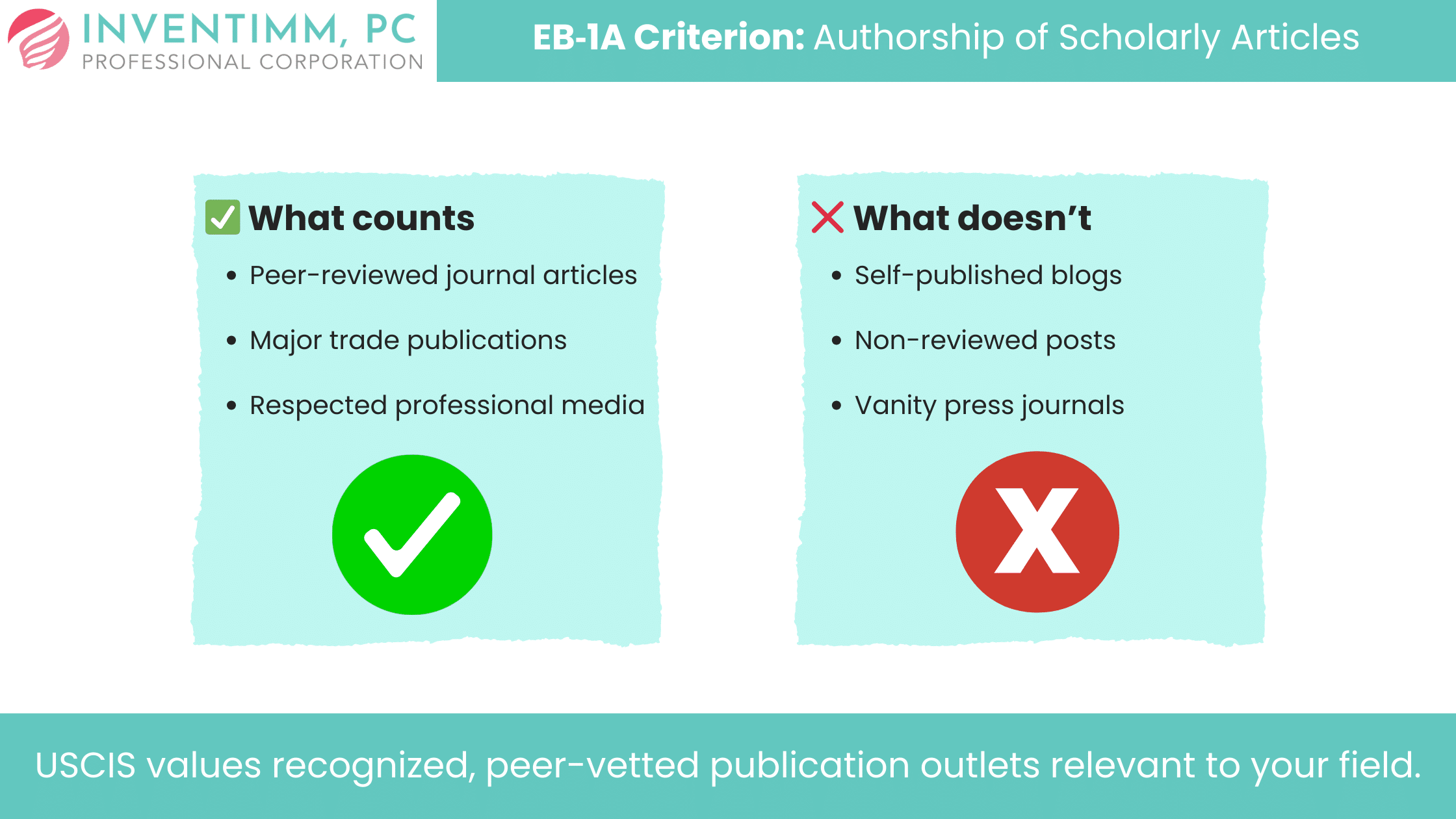
At first glance, this might sound like a straightforward “check-the-box” requirement—publish a few articles, show them to USCIS, and be done. However, as with all EB‑1A criteria, quality over quantity (and robust documentation) is crucial. Adjudicators look beyond mere publication volume to assess the impact, prestige, and recognition of those publications in determining whether the applicant’s overall achievements are truly “extraordinary.”
1.1 Why Authorship Matters
In many fields, authoring significant articles in recognized journals, major trade publications, or influential media is one of the clearest indicators that others value your expertise. In academic and research contexts, publishing peer-reviewed work typically signals that you have made a noteworthy contribution. In business or entrepreneurial contexts, writing in respected industry outlets can show your thought leadership and domain expertise.
Overall, USCIS regards reputable publications as evidence that peers (and professional gatekeepers) trust your ideas enough to disseminate them widely. This is especially true if your articles have a tangible impact on the field—prompting citations, follow-up research, innovations, or new industry practices.
2. Understanding the Final Merits Determination
Beyond fulfilling three of the ten regulatory criteria, EB‑1A applicants must satisfy a “final merits determination” or “totality of the evidence” test. In essence, even if you check the authorship box, plus two others, the adjudicator can still deny the petition if, in totality, your achievements do not appear indicative of being at the pinnacle of your field.
2.1 How Authorship Factors Into Final Merits
Authorship serves not only as one of the “three criteria” you can claim but also as a strong supporting point for your overall profile. If your articles:
- Attract substantial media or trade press attention,
- Influence industry standards or academic research,
- Lead to your invitation to present at top conferences,
- Result in you being sought after for peer review opportunities,

then authorship becomes more than just a single box—it becomes a catalyst that enhances other areas of your EB‑1A case (such as original contributions of major significance, membership in selective associations, or judging the work of others).
3. The Regulatory Language: Authorship of Scholarly Articles
The typical language for the EB‑1A authorship criterion is:
“Evidence of the alien’s authorship of scholarly articles in the field, in professional or major trade publications or other major media.”
Breaking it down:
- Scholarly Articles in the Field:
- Generally refers to peer-reviewed journals, conference proceedings, white papers, or recognized trade journals.
- The content must be relevant to your claimed field of expertise.
- Generally refers to peer-reviewed journals, conference proceedings, white papers, or recognized trade journals.
- Professional or Major Trade Publications:
- Must be recognized outlets that professionals in your discipline respect and read.
- Could be top-tier academic journals, widely circulated industry magazines, or trade publications that shape industry conversations.
- Must be recognized outlets that professionals in your discipline respect and read.
- Major Media:
- Sometimes includes mainstream outlets if they have a robust reputation and wide circulation in your specific niche. For entrepreneurs or business experts, certain leading business publications (e.g., Forbes, Harvard Business Review, etc.) might qualify.
- For more technical or scientific fields, major media might be an especially prominent scientific journal (e.g., Nature, Science) or a similarly top publication in your subfield.
- Sometimes includes mainstream outlets if they have a robust reputation and wide circulation in your specific niche. For entrepreneurs or business experts, certain leading business publications (e.g., Forbes, Harvard Business Review, etc.) might qualify.
3.1 The Shift Toward Quality
Over the years, USCIS has become increasingly aware of predatory or pay-to-publish journals and questionable “publishing” avenues that exist solely to help individuals claim a publication record. As a result, more than ever, the prestige, selectivity, and recognized standing of the publication platform is critical.
If your articles appear in low-tier, little-known, or exclusively pay-to-publish journals (with no rigorous peer review or editorial standards), USCIS may discount or question that evidence, especially during final merits. Conversely, articles in even a small number of high-quality, influential publications can go a long way in demonstrating extraordinary ability.
4. Deconstructing “Quality of Publications”
4.1 What Counts as “High Quality”?
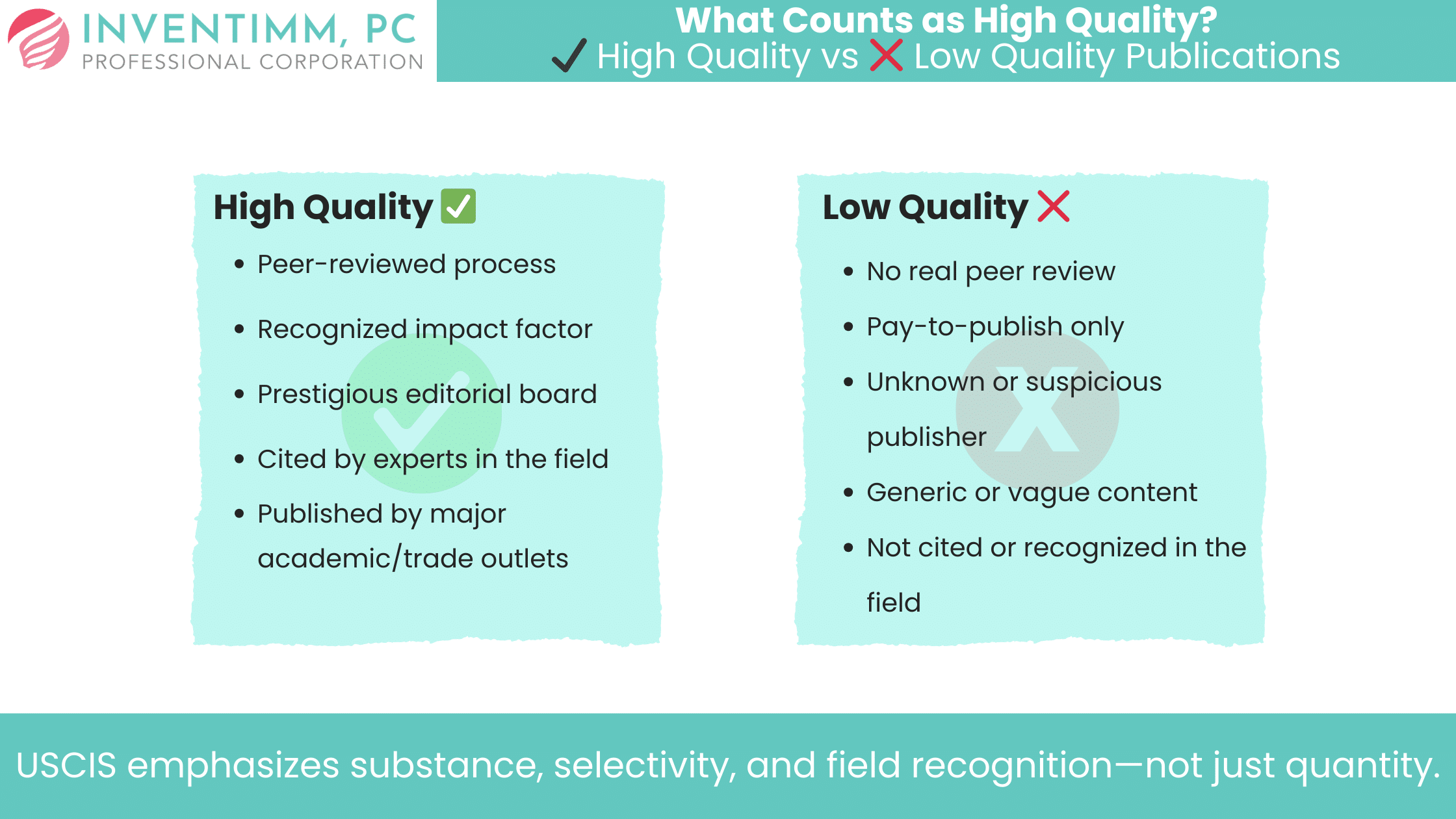
“High quality” can be demonstrated in different ways, depending on your field. Some common signals include:
- Impact Factor (IF) for academic journals:
- Journals with a high IF in recognized ranking systems (e.g., Clarivate Analytics’ Journal Citation Reports) show that the publication is influential.
- USCIS does not require you to be in a top 1% impact factor journal, but if your journal’s IF is high relative to your subfield, highlight it.
- Journals with a high IF in recognized ranking systems (e.g., Clarivate Analytics’ Journal Citation Reports) show that the publication is influential.
- Circulation or Readership Metrics in industry/trade publications:
- If you write for a major engineering magazine read by tens of thousands of professionals, that wide readership conveys an influential platform.
- Online metrics such as unique monthly visitors can be included for digital-only journals or magazines, but ensure they are reputable.
- If you write for a major engineering magazine read by tens of thousands of professionals, that wide readership conveys an influential platform.
- Prestige or Historical Standing:
- A publication that is widely known as a “leading voice” in your niche—perhaps it’s the official journal of a major professional society—often has inherent credibility.
- If the editorial board includes recognized experts, or if the journal regularly features prominent authors in your sector, mention that.
- A publication that is widely known as a “leading voice” in your niche—perhaps it’s the official journal of a major professional society—often has inherent credibility.
- Selectivity:
Demonstrate acceptance rates or editorial rigor if possible. If the conference or journal has an acceptance rate under 15%, for example, that is often persuasive evidence of exclusivity.
4.2 How to Document Quality
When submitting an EB‑1A petition, do not assume USCIS is aware of your publication’s reputation. Provide:
- Evidence of editorial standards (e.g., peer-review policy).
- Information about acceptance rates or the typical caliber of authors who publish there.
- Citations or references to show that your publications are widely cited or recognized.
- A statement (from the journal’s website or letter from the editor) describing how the journal or trade publication is widely respected in your subfield.
5. Showcasing Authorship as Impactful Evidence
Authorship can be transformational when it triggers or supports other achievements. USCIS increasingly looks for synergy among your EB‑1A evidence—where one criterion demonstrates or amplifies your standing in others. Let’s explore how your published work can ripple into other EB‑1A criteria.

5.1 Original Contributions of Major Significance
Many petitioners claim the criterion of “original scientific, scholarly, artistic, athletic, or business-related contributions of major significance.” If your publications:
- Advance a new methodology or technology,
- Spark a wave of follow-up research or adoption,
- Lead to widespread industry usage (for entrepreneurs, maybe your published strategy is being replicated by major brands),
then your authorship underscores the significance of your contribution. You can use citation metrics, adoption case studies, or references in others’ papers to show that your articles had a tangible, major impact on the field.
5.2 Judging/Peer Review
If you become known for your published work, you might be invited to peer review articles for that same journal—or perhaps a competitor’s prestigious journal. Likewise, you could be asked to serve as a judge at conferences or on editorial boards. This synergy is crucial:
- The reason you were invited to judge: your recognized expertise and published authority.
- The outcome: your reviewing or judging role satisfies another EB‑1A criterion—“Participation as a judge of the work of others in the same or an allied field.”
Hence, authorship can lead directly to being recruited as a reviewer/judge, checking off another box while reinforcing your final merits argument: you are consistently recognized for your field leadership.
5.3 Media Coverage
Substantial, high-quality publications sometimes generate media coverage about you. For instance:
- A top trade magazine might interview you after your groundbreaking article on an emerging technology or entrepreneurial strategy.
- Business or mainstream media might pick up your article’s insights, resulting in an editorial or commentary featuring your name and expertise.
That coverage potentially fulfills the EB‑1A requirement for “published material about you in professional or major trade publications,” another separate criterion. In other words, a single article can spawn separate articles about you, stacking multiple forms of evidence.
5.4 Conference Invitations and Speaking Engagements
Authorship often leads to speaking engagements:
- You author a paper in a top-tier journal.
- Organizers of a recognized conference learn of your research and invite you to present (or even keynote).
- You can now also claim “display of your work” if it’s showcased at a significant event, or use the talk to support the leading or critical role criterion if you are entrusted with a major conference session.
Thus, a high-impact publication can become an anchor that fosters multiple additional achievements—strengthening your overall petition.
6. Authors Who Are Not Academic Researchers: Industry Experts and Entrepreneurs
One common misconception is that authorship evidence applies only to academics or researchers. In reality, the EB‑1A regulations do not limit “scholarly articles” to formal academic circles. Industry experts, entrepreneurs, and thought leaders regularly publish in:
- Leading trade journals: e.g., official magazines of major professional associations.
- Business or technology outlets: e.g., well-respected business publications that are recognized for editorial rigor.
- White papers or technical bulletins published under the auspices of a major company or recognized authority.
6.1 Navigating the “Nature and Science” Myth
It’s true that being published in extremely high-impact scientific journals (Nature, Science, Lancet, or top-tier engineering journals) can be very persuasive. But not everyone operates in a domain where such journals are feasible, especially entrepreneurs or specialized professionals in narrower fields. USCIS does not require all authors to publish in these elite scientific outlets. They simply want to see that you have published in widely respected professional media within your area.
6.2 Strategies for Industry Professionals
- Identify Key Trade Publications: In pharmaceuticals, that might be Pharmaceutical Executive or BioPharm International. In software engineering, it might be the Communications of the ACM if it’s recognized in your subdiscipline.
- Contribute Case Studies or Thought Leadership Pieces: If you are the CEO or CTO of a startup, authoring articles that demonstrate your specialized acumen (e.g., “How We Brought a Novel Medical Device to Market in Record Time”) can highlight the significance of your business contribution.
- Highlight Your Unique Approach: USCIS wants to see how your published perspectives differ from generic commentary. If you introduced a new framework, algorithm, or process that others have adopted, mention that.
- Document Credibility: Provide background on these trade outlets—who reads them, how often they’re cited, or any editorial selection process (e.g., the publication might only accept articles after editorial board review or expert screening).
6.3 For Entrepreneurs: A Path to Recognition
For entrepreneurs, publishing can be an excellent marketing and credibility tool. By placing articles in recognized outlets, you are effectively:
- Showcasing your company’s innovation.
- Building a reputation as a thought leader.
- Potentially attracting both media coverage and conference invitations.
When reviewing your petition, USCIS will see that your peer group recognizes you enough to amplify your voice, again reflecting that you may be at the top of your field.
7. Building a Persuasive Authorship Portfolio
7.1 Quality vs. Quantity
When it comes to EB‑1A authorship, quality typically trumps quantity. A smaller set of truly impactful, rigorously peer-reviewed, or widely read articles can be more compelling than a long list of publications in unknown or minimally vetted outlets.
7.2 Linking Articles to Field Impact
Go beyond listing publication titles. Demonstrate why each article matters:
- Include mention of citations, references, or follow-up industry adoption.
- Show if an article introduced a recognized concept or changed best practices.
- Attach editor or peer comments (where permissible) lauding the novelty of your work.
7.3 Addressing Multiple Audiences or Mediums
An author with a diverse portfolio of recognized publications—some academic, some in mainstream trade magazines—can strengthen an EB‑1A claim. It suggests your influence extends beyond just academic peers. For example:
- One peer-reviewed journal article in a specialized subdiscipline.
- One trade magazine article with broad industry coverage, bridging academic theory with real-world practice.
- An article in a major media outlet reaching a broader, possibly global audience.
When combined, these illustrate that you are recognized across the spectrum of your field.
7.4 Documentation Essentials
When presenting your authorship evidence:
- Full Copies (or excerpts) of the articles, including cover pages showing the journal or publication name, ISSN, publication date, and your authorship listing.
- Translated Versions if in another language (must be certified translations).
- Publication/Editorial Information: The more you detail about the publication’s editorial standards, history, or prestige, the better.
- Citations or References: Tools like Google Scholar, Web of Science, or Scopus can show how many times your paper has been cited.
- Testimonials: Letters from editors, co-authors, or domain experts praising the significance of your published work.
8. Common Pitfalls and How to Avoid Them
8.1 Overreliance on Dubious Journals

Publishing in journals with predatory practices—where authors pay steep fees for immediate acceptance without real peer review—can undermine credibility. If an adjudicator suspects your publication history primarily consists of “vanity journals,” they might discount the authorship evidence. Avoid:
- Journals with no legitimate editorial board or peer-review process.
- Journals boasting guaranteed acceptance or extremely short turnaround from submission to publication.
8.2 Submitting Articles Unrelated to Your Claimed Field
USCIS will look to see if your publications align with the field of extraordinary ability you claim. For example, if you’re applying as a data science expert but your articles are primarily about general travel or photography, they likely won’t help your EB‑1A claim.
8.3 Failing to Provide Context
Simply listing your publications in a CV without any supporting evidence is risky. An adjudicator with limited time and no specialized knowledge of your field might not understand the outlet’s reputation or the relevance of your article. You must:
- Provide proof the journal or magazine is recognized in your field.
- Explain your article’s significance so the adjudicator understands its value.
8.4 Ignoring the “Scholarly Article” Requirement
For EB‑1A authorship, the standard mentions “scholarly articles in the field, in professional or major trade publications or other major media.” Some individuals try to use:
- Short blog posts on personal websites, or
- Unvetted LinkedIn articles or social media posts.
While such writings might help demonstrate domain knowledge, they typically do not meet the threshold of a “scholarly article” in a recognized professional venue, unless the blog is itself an established platform in your sector with recognized editorial standards.
9. Synergy With Other EB‑1A Criteria and Final Merits
9.1 Leading or Critical Role
If your authorship shapes a major organization’s direction (e.g., you lead the publication strategy of a large pharma company, or you were the head of an editorial team that set new standards in your industry), you might bolster the leading or critical role criterion.
For instance, if your role as an editor-in-chief or lead contributor in a recognized publication is integral to that publication’s success, that can show both authorship and a leadership capacity.
9.2 High Salary or Commercial Success
Sometimes, consistent publication in major outlets correlates with above-average remuneration or commercial success, especially for entrepreneurs or consultants. If you can show that your published expertise drives client demand or company valuation, this might help with the high salary or commercial success angle (though that’s a separate, more specialized EB‑1A criterion).
9.3 Membership in Selective Organizations
Certain associations or academies require members to have significant publications. If you gained membership in a highly selective professional society primarily based on your publication record, you could demonstrate both the membership criterion and authorship simultaneously.
9.4 Original Contributions and Peer Review
As explored earlier, recognized authorship can lead to:
- Peer review or editorial board invitations (fulfilling the “judging” criterion).
- Industry adoption (strengthening your “original contributions” criterion).
In other words, authorship stands at the nexus of multiple EB‑1A prongs when properly documented.
10. Illustrative Case Study (Hypothetical)
10.1 Profile
- Name: Dr. X
- Field: Renewable Energy Storage
- Position: Senior Research Scientist at a mid-sized cleantech company
10.2 Authorship Path
- Peer-Reviewed Publications: Dr. X has authored three papers in a recognized energy engineering journal with a moderate but respectable impact factor, focusing on new battery optimization techniques.
- Trade Magazine Features: Dr. X wrote a detailed technical piece for a leading “Energy Today” magazine, which is read by thousands of industry professionals.
- Media Collaboration: Dr. X contributed an opinion piece on green storage solutions to a well-known business publication with an established editorial vetting process.
10.3 Additional Impacts
- Conference Invitations: Because of these articles, Dr. X was invited to speak at the annual International Energy Storage Summit.
- Industry Adoption: At least two other companies began referencing Dr. X’s technique in their product strategies, with one company citing Dr. X’s “breakthrough methodology” in its press release.
10.4 EB‑1A Thread
- Authorship: The portfolio of five recognized, well-documented publications meets the authorship criterion.
- Judging: The editorial team for “Energy Today” asked Dr. X to review unsolicited technical submissions from new authors—fulfilling the “judge of others’ work” criterion.
- Original Contributions: Dr. X’s new battery optimization method was singled out by peers, leading to at least one major adoption. This can support the “original contributions of major significance” criterion.
- Final Merits: By linking all of this evidence together, Dr. X shows consistent recognition in renewable energy storage. The synergy becomes compelling: each piece fortifies the narrative that Dr. X is indeed among the small percentage at the top of this specialized field.
11. Practical Tips for Strengthening Your Authorship Record
11.1 Plan Ahead (If Possible)
If you are strategizing an EB‑1A petition but have limited publications, consider focusing efforts on:
- Submitting to recognized, if modest, peer-reviewed journals in your niche—journals that your peers respect.
- Writing a high-quality trade article in a well-known industry magazine.
- Collaborating with established figures who can co-author with you, thereby increasing the credibility of your article’s acceptance.
Publishing typically takes time—peer review can last months—so start early if you see EB‑1A in your future.
11.2 Document Citation Metrics
- If your articles have Google Scholar or Scopus data, present these metrics in a clear manner.
- For trade articles, references or trackable mentions from other industry platforms can be equally powerful.
11.3 Collect Editor or Publisher Letters
Ask editors (especially for specialized trade outlets) to write a letter explaining:
- Why they chose to publish your article.
- How selective the process is.
- The editorial standards they uphold.
These letters are direct evidence of the high-level editorial confidence in your work.
11.4 Archive Online Mentions
If your article is featured, cited, or discussed on notable websites, forums, or news sites, take screenshots or gather web links. You can show your article’s online presence to demonstrate interest and impact.
12. Final Merits Considerations: Authorship as an Anchor
12.1 Telling a Cohesive Story
Under final merits, USCIS looks at the totality of your achievements and how they demonstrate sustained national or international acclaim. Authorship can be a central anchor if your publications:
- Paint a narrative of someone whose ideas are shaping the discourse in the field.
- Explain how your recognized writing spurred further achievements.
- Demonstrate peer endorsement, since each accepted article implies editorial approval based on perceived value and expertise.
12.2 Cross-Pollination With Other Criteria
Never isolate authorship evidence. Reference it alongside:
- Original contributions: “As discussed in my Journal of ABC publication, I introduced the methodology….”
- Membership: “My Fellow status in the XYZ Society was granted partially because of my groundbreaking published work recognized by the society’s membership board….”
- Judging: “After my peer-reviewed article gained significant traction, I was invited to serve as a reviewer for…”
This approach shows USCIS how your authorship weaves into a broader tapestry of recognition, culminating in a persuasive final merits argument.
13. Authorship for Entrepreneurs and CEOs: A Competitive Edge
13.1 Why Top Entrepreneurs Have Robust Authorship
Entrepreneurs and executives in certain industries—particularly tech, pharma, and finance—often produce white papers, columns, or major press op-eds detailing:
- Their approach to disruptive innovations,
- Their leadership on key organizational strategies,
- Industry analyses or predictions that garner attention.
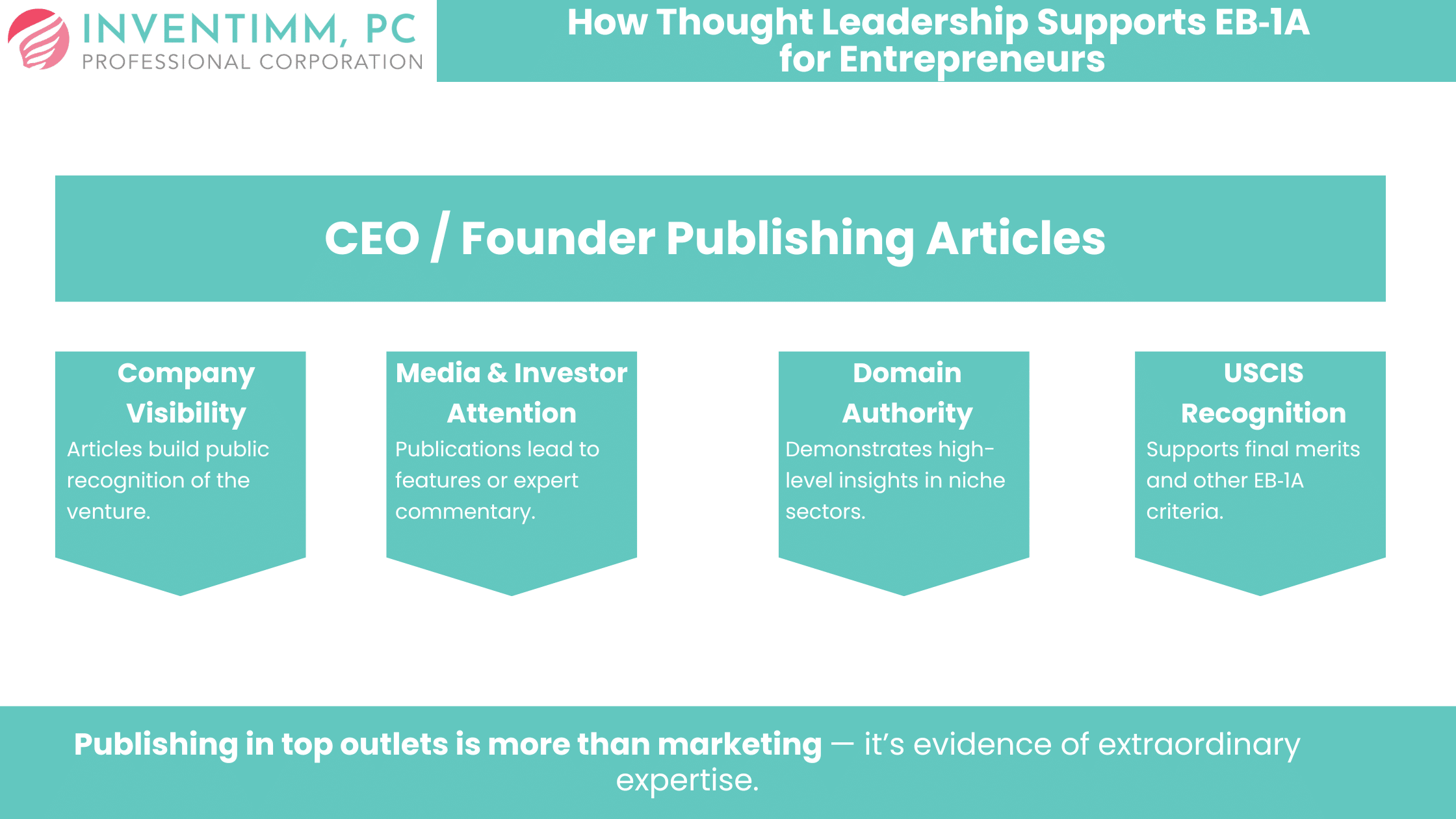
These articles not only promote the company but also serve as proof of the executive’s top-level insight. USCIS acknowledges that in business or entrepreneurial settings, recognized “thought leadership” is akin to academic “scholarly contributions.”
13.2 Publication Outlets for Entrepreneurs
- Industry-Specific Platforms: For instance, if you’re in pharmaceutical entrepreneurship, major recognized pharma publications or regulatory journals can highlight your insights.
- High-Level Business Journals or News Sites: While extremely selective, placements in Harvard Business Review, MIT Sloan Management Review, or similarly prestigious outlets can hold significant weight.
- Respected Online Media: If you wrote for a recognized tech news site or a well-known business platform with an editorial board, that can be equally persuasive—provided you can document its credibility and editorial standards.
13.3 Leverage for Overall Acclaim
- Company Visibility: Well-publicized articles can bring media coverage for your venture, potentially satisfying “published material about you” if the coverage references you as the author or highlights your expertise.
- Investor/Industry Validation: Positive reception to your published perspectives (e.g., endorsements by other experts, high engagement on professional platforms) underscores your status as a recognized figure in that domain.
- Comparison With Top Competitors: If your competitors—CEOs or CTOs in the same sector—are known for publishing authoritative pieces, matching or exceeding that track record signals that you operate at the same top tier.
14. Addressing the “Not Enough Time” Constraint
Some petitioners realize late in the process that they lack a strong authorship record. While building a robust publication record typically requires planning, there are ways to fast-track or at least enhance the quality of your existing portfolio:
- Target a High-Profile Trade Publication: The timeline for acceptance may be shorter than an academic journal. Many respected industry magazines allow carefully vetted guest articles with a quicker turnaround, especially if you propose a timely, relevant topic.
- Co-Author with a Recognized Leader: Collaboration can shorten editorial hesitation. A co-author who already has recognized standing in the field can lend credibility, smoothing acceptance.
- Focus on Depth Over Breadth: If you have only one or two meaningful articles, emphasize their significance thoroughly. Provide detailed letters of support from editors or well-known professionals attesting to the novelty and importance of these pieces.
15. Frequently Asked Questions (FAQ)
What is considered a scholarly article for EB‑1A?
A scholarly article for EB‑1A is a professionally vetted publication that advances knowledge in your field. This typically means peer-reviewed academic journals, major trade publications, or respected industry media. The key is editorial or expert review and recognition within your professional domain.
Do I need to publish in top-tier journals like Nature or Science?
No. EB‑1A does not require elite journals. Publishing in widely respected journals or trade publications with a recognized audience and editorial standards is sufficient—as long as they’re relevant to your field.
How many articles are required for EB‑1A?
There is no fixed number. Quality and impact matter more than volume. A few influential, well-documented articles often carry more weight than many lesser-known ones.
Do blog posts or LinkedIn articles count as scholarly authorship?
Not usually. Blog posts and self-published articles generally lack the editorial review required under EB‑1A. Exceptions may exist if the platform is highly recognized and maintains strict vetting standards.
How can I prove that a publication is reputable?
You can show peer-review policies, acceptance rates, circulation stats, the prominence of its editorial board, or letters from editors. Third-party references or citation databases can also help establish credibility.
Can authorship alone get my EB‑1A approved?
No. Meeting three criteria is required, and authorship is just one. However, strong authorship often reinforces other areas of your case—like original contributions, judging, and final merits.
How do citations help my EB‑1A petition?
Citations show your work is valued and referenced by others in your field. They help demonstrate impact and support both the authorship and original contribution criteria.
Is one article enough to meet the EB‑1A authorship requirement?
One article may be sufficient if it is in a highly respected outlet and has had measurable influence. However, more than one high-quality piece is generally recommended to strengthen your case.
Can articles about my company help with authorship?
Yes—if you authored the content and it appears in a reputable outlet with editorial oversight. Promotional press releases don’t typically count unless they provide expert insight and are published by recognized platforms.
16. Conclusion: Authorship as a Cornerstone of Extraordinary Ability
Authorship of scholarly and influential articles holds a special position within EB‑1A petitions. It is often one of the most direct ways to demonstrate that your peers—and, by extension, your industry—acknowledge you as a leading mind whose ideas are worth documenting and disseminating. Whether you are:
- An academic researcher publishing in high-impact scientific journals,
- A technical specialist writing for niche, yet respected, industry outlets,
- An entrepreneur establishing thought leadership in major business media,
authorship can be a powerful pillar of your overall argument. By connecting your published works to other EB‑1A criteria—such as original contributions, peer review invitations, conference keynotes, or leadership roles—you create an interlinked evidence portfolio that strongly supports a successful final merits determination.
16.1 Key Takeaways
- Strive for High Quality: One impactful publication in a recognized journal or outlet often outweighs several lesser-known or pay-to-publish articles.
- Demonstrate Field Impact: Highlight any citations, industry adoption, media coverage, or invitations stemming from your publications.
- Document Everything: Provide the articles themselves, editorial references, and thorough background on each publication.
- Leverage Synergies: Use your authorship to link into other EB‑1A criteria, creating a cohesive narrative of sustained acclaim.
- Final Merits Emphasis: Always frame your authorship evidence in a way that underscores you are among the small percentage at the top of your field.
16.2 Looking Ahead
Securing EB‑1A approval is about painting a total picture of extraordinary ability. Authorship evidence, when properly curated and contextualized, can serve as the backbone of that picture—or at least a highly influential section of it. Whether you are a seasoned academic or a rapidly rising industry innovator, establishing yourself as a published authority in widely recognized outlets resonates strongly with USCIS. Ultimately, it’s about showing that your knowledge and expertise are not only advanced but endorsed at a level consistent with extraordinary ability.
Disclaimer: This information is provided for educational purposes and does not constitute legal advice. EB‑1A petitions are complex, and each applicant’s situation is unique. Prospective petitioners should consult a qualified immigration attorney to develop a tailored strategy for authorship and other EB‑1A criteria.
Categories: U.S. Immigration